

Fix Crawlspace Moisture to Eliminate Pests in Greenville
Stop the cycle at the source
Why Eastern NC Geography and Climate Create Ideal Conditions for Crawlspace Pests
Homeowners across Greenville and Pitt County face a unique environmental challenge. The region sits within the low-lying Atlantic Coastal Plain, where the Tar River meanders through clay-heavy soils that trap water beneath foundations. This geological combination creates ideal nesting conditions for invasive pests throughout the year.
When spring storms drench the area and summer humidity pushes past 85%, traditional vented crawlspaces become saturated. The dense clay loam beneath Greenville homes prevents rapid drainage, leaving standing puddles on dirt floors from April through October. Unlike sandy soils found closer to the coast, these soils hold moisture against foundation walls and subflooring for weeks after rain events end.
By late June, when afternoon temperatures routinely reach the low 90s, relative humidity inside closed crawlspaces climbs well above 70%. At this threshold, wood moisture content rises, fungal spores begin to bloom, and insects detect the damp conditions from yards away. American cockroaches, camel crickets, and subterranean termites are particularly drawn to this environment, seeking out the consistent moisture and decomposing organic matter beneath homes built on pier-and-beam or block foundations.
Understanding this regional pattern is the first step in addressing recurring insect activity indoors.
The Stack Effect: How Contaminated Crawlspace Air Circulates Through Your Home
Many property owners assume that whatever happens beneath the house remains isolated from living areas. Basic physics contradicts this assumption through a natural phenomenon called the stack effect. Warm indoor air rises through your home and exits via the attic. As heated air escapes, it creates negative pressure on lower levels, pulling replacement air upward from the crawlspace like a steady vacuum.
Research shows that up to 50% of the air you breathe on your first floor originates directly from your crawlspace. When that crawlspace is plagued by trapped moisture, standing water, and nesting pests, your HVAC system continuously draws contaminated air into bedrooms, kitchens, and living rooms. Airborne mold spores, dust mite allergens, rodent dander, and insect waste particles circulate through ductwork and floor penetrations, degrading indoor air quality month after month.
Homeowners often notice musty odors near baseboards or feel unusual humidity on hardwood floors without connecting these symptoms to crawlspace conditions. Cupping floorboards, peeling wallpaper along exterior walls, and increased allergy symptoms indoors all point to the same root cause. Addressing the moisture source beneath the home becomes essential not only for controlling pests but also for protecting respiratory health and structural integrity.
This connection between foundation conditions and indoor air quality drives the need for targeted moisture management strategies.
Which Pests Thrive in Damp Greenville Crawlspaces and Why They Return
Insects and rodents select your home based on three survival requirements: food sources, warmth, and moisture. In Eastern North Carolina, crawlspaces provide an endless supply of the third element. When relative humidity exceeds 70% in an open-vent crawlspace, several destructive species move in quickly.
American cockroaches, often called waterbugs, are among the most common invaders. These large roaches thrive in damp, decomposing organic matter and use plumbing penetrations to travel directly from the crawlspace into bathrooms and kitchens. Once established, they reproduce rapidly in the moist subflooring.
Camel crickets, also known as cave crickets, gather in massive numbers beneath homes during humid summer months. These pests damage fabrics, cardboard, and insulation while attracting predatory spiders and mice. Homeowners in Greenville frequently report hundreds of these insects appearing overnight after heavy rainfall.
Subterranean termites and wood-boring beetles target joists and subflooring softened by high wood moisture content. Damp conditions make it effortless for these wood-destroying insects to compromise structural framing, leading to sagging floors and costly repairs.
Rodents seek out damp fiberglass insulation to build nests, chewing through electrical wiring and leaving disease-carrying droppings behind. Rats and mice enter through foundation cracks and gaps around utility lines, establishing colonies that grow unchecked in poorly maintained crawlspaces.
Each of these pests returns as long as the moisture remains.
Why Surface Treatments and DIY Methods Fail to Resolve Moisture-Driven Infestations
Over-the-counter bug sprays and basic perimeter treatments only eliminate the pests you see at the moment of application. These surface-level interventions do nothing to address the damp environment fueling the infestation beneath the home. When cockroaches, crickets, and rodents nest in saturated subflooring, chemical sprays applied to baseboards and door thresholds provide temporary relief at best.
Homeowners often spray monthly, set traps continuously, and maintain spotless kitchens, yet insects continue appearing indoors. The frustration stems from treating symptoms rather than causes. If the crawlspace remains humid and poorly ventilated, pests will continue migrating upward into living spaces no matter how often you treat visible surfaces.
DIY vapor barriers purchased from big-box retailers frequently tear, shift, or fail to cover all exposed soil. Without proper sealing around piers, plumbing penetrations, and foundation walls, ground moisture continues evaporating upward. Inadequate dehumidification allows relative humidity to climb back above critical thresholds within weeks.
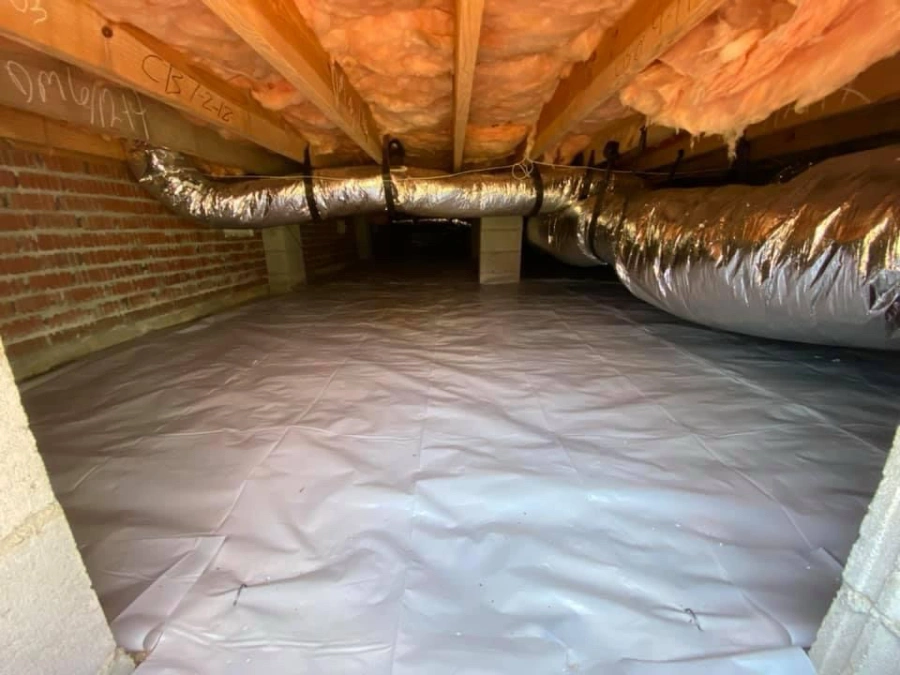
True prevention requires eliminating the moisture that makes your home hospitable to pests in the first place. This involves installing heavy-duty vapor barriers across dirt floors to block ground moisture, sealing foundation vents to prevent humid outdoor air from entering, and adding dedicated dehumidifiers to control relative humidity year-round. Pest exclusion work, including sealing cracks and gaps around utility lines, blocks entry points between the subfloor and living quarters.
The Integrated Approach: Combining Pest Eradication with Long-Term Moisture Management
Lasting protection against crawlspace pests requires a two-pronged strategy that addresses both active infestations and the underlying moisture conditions. This integrated approach pairs targeted extermination with permanent environmental modifications.
The first phase involves eliminating existing pest populations through precise treatments tailored to the species nesting beneath your home. Baiting systems, targeted liquid applications, and exclusion work remove cockroaches, rodents, and crickets from subflooring and foundation voids. This step clears the immediate problem but does not prevent reinfestation.
The second phase focuses on moisture management. Installing a heavy-duty poly vapor barrier across the entire dirt floor prevents ground moisture from evaporating upward into framing and floorboards. Sealing foundation vents blocks humid outdoor air from entering the crawlspace during summer months. A dedicated crawlspace dehumidifier maintains relative humidity below 60% year-round, creating conditions where pests, mold, and wood rot cannot survive.
Exclusion work completes the system by sealing entry points. Gaps around utility lines, cracks in foundation walls, and openings along sill plates receive durable sealant, blocking rodents and insects from migrating between subfloor cavities and living quarters.
This dual-defense approach delivers lasting results for homeowners dealing with recurring pest activity, musty odors, and structural concerns. Whether you face cockroach sightings, sagging floors, or persistent humidity indoors, addressing both pests and moisture protects your investment and indoor air quality over the long term.